

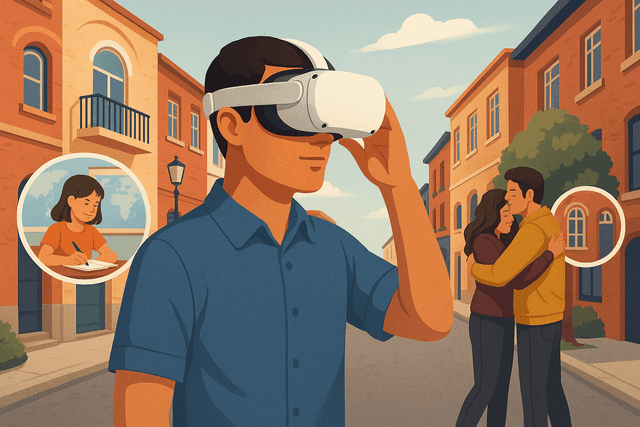
Every now and then, a VR app comes along that is less about chasing high scores and more about capturing what makes real life meaningful. Revisit on Meta Quest is one of those experiences. It is a VR travel app built around Street View and Google Earth imagery, but the real subject is not technology at all – it is memory, nostalgia, long-distance relationships, and the quiet joy of seeing the world again without leaving home.
According to its core description, Revisit lets users browse almost any location visible in Google Maps Street View and present it directly in VR, as if they were physically standing there. Instead of tapping a screen, you lift your head and see Paris, London, or a small side street in Japan filling your field of view. This simple shift from flat display to immersive headset is what turns VR travel, relaxation, and tourism from a nice idea into something you can actually feel.
A VR Street View App Built Around Memory, Not Maps
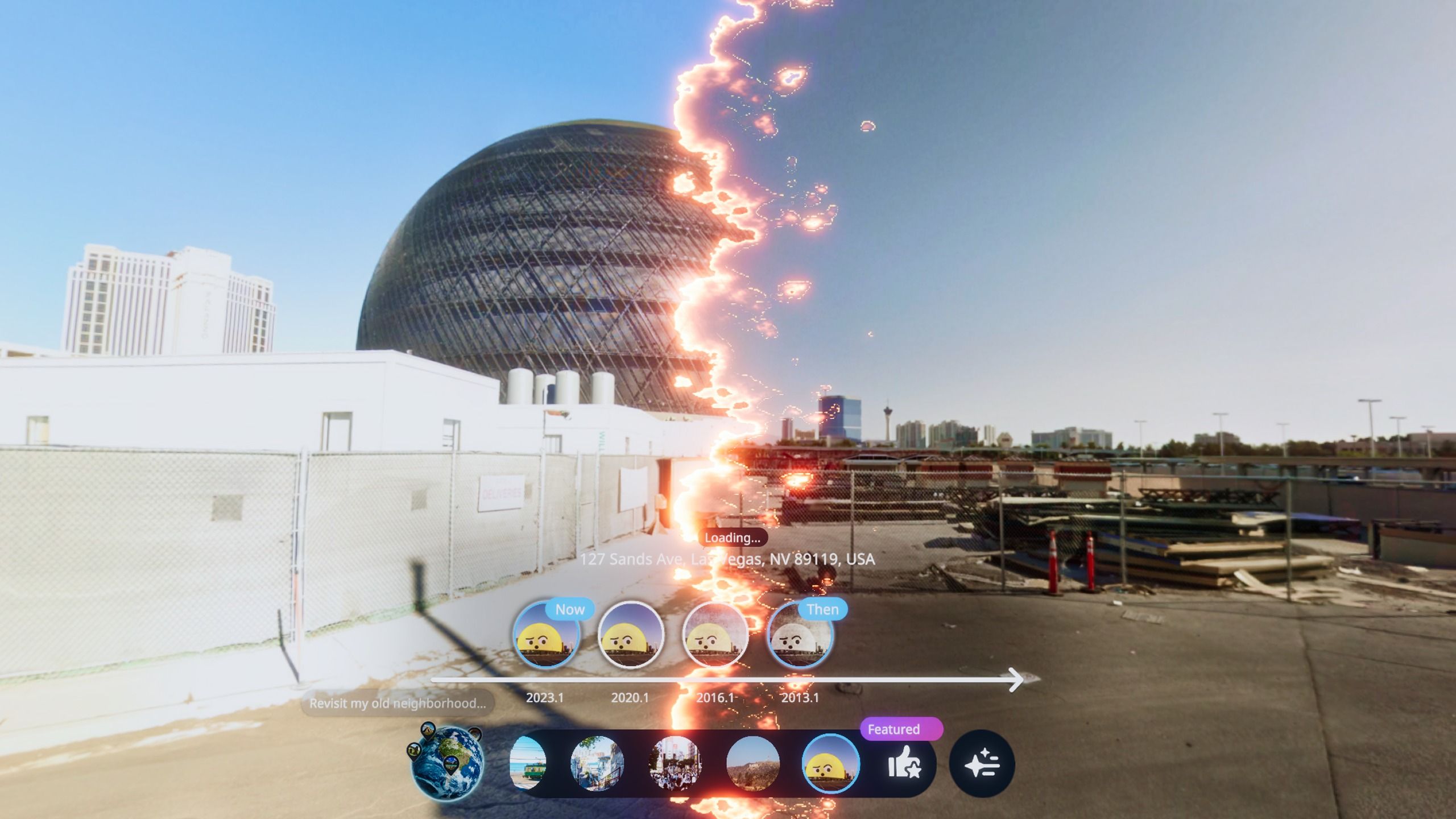
Most people first learn about VR street experiences as a navigation tool: you “drop” a pin onto a map and click along the road. Revisit starts from the same data but inverts the purpose. This is not about finding the shortest route; it is about revisiting places that matter to you. Old neighborhoods, honeymoon destinations, the street outside your first apartment – Revisit turns these locations into three-dimensional memory capsules.
The app’s feature description emphasizes exactly this angle: users can roam Street View locations as if truly on the spot, which makes it ideal for reliving precious moments. You are no longer scrolling past generic travel photos; you are stepping into a familiar intersection, listening in your mind to the conversations you once had there. It’s a kind of “time travel” driven not by sci-fi effects, but by your own history stitched onto Google’s imagery.
From an expertise perspective, this fits perfectly with what VR researchers call “presence” – the psychological sense of being in another place. Street imagery in a browser can look detailed, but it rarely produces that feeling. In a headset, when the scene wraps around you and responds to your head movement, presence kicks in. That presence is exactly what makes old memories feel vivid instead of distant.
Stepping Inside Google Earth’s Streets on Meta Quest
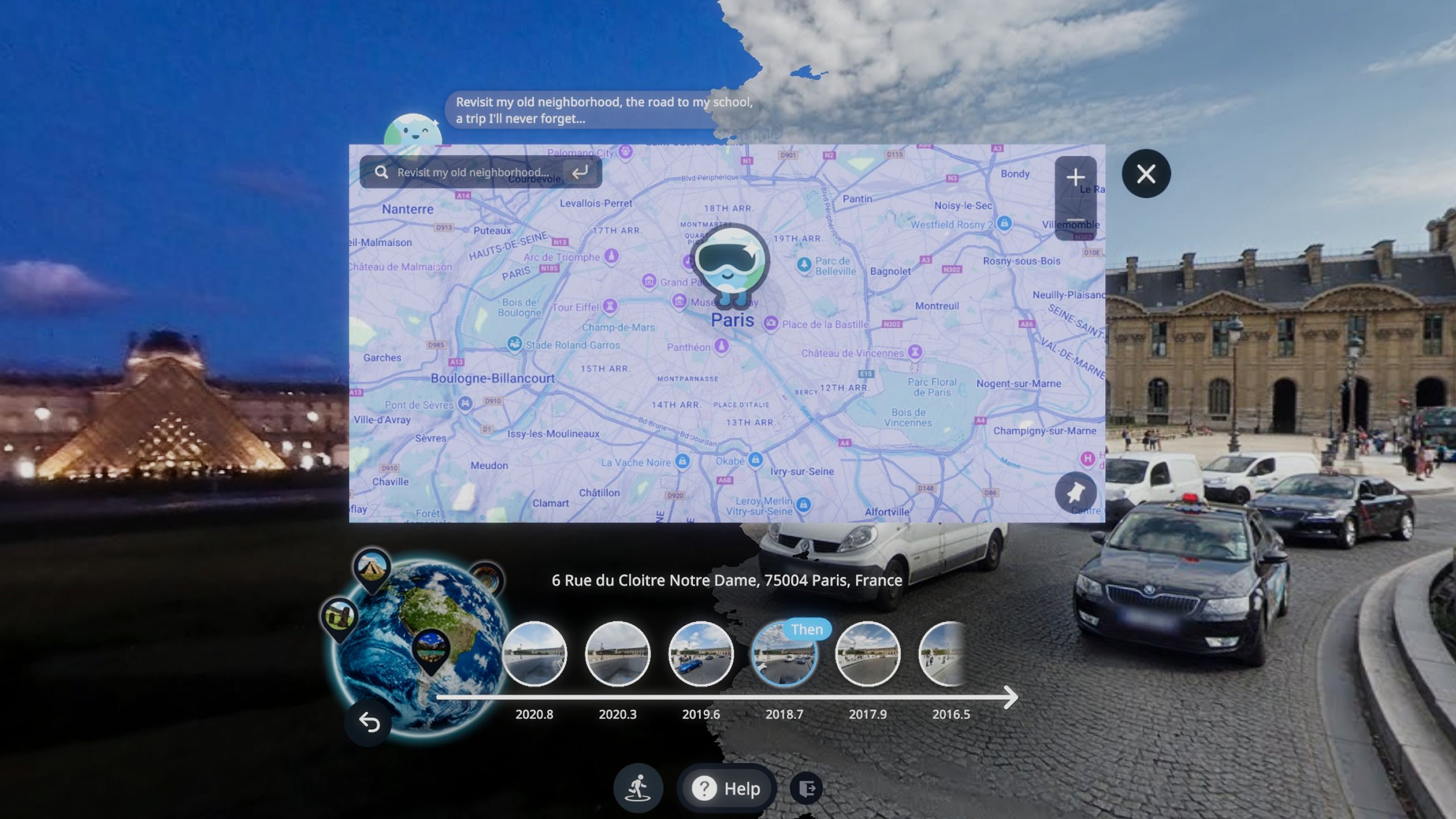
On the technical side, Revisit is a straightforward but clever Meta Quest application. It takes the familiar Street View and Google Earth layer – content users already trust – and brings it into VR in a comfortable way. Instead of complex controllers or game mechanics, the core interaction is simple: choose a spot on the planet, load the view, then look around naturally. Movement is typically along the same nodes you would see on a laptop, but experienced from eye-height instead of mouse level.
Because the app runs on Meta Quest hardware such as Quest 3 and Quest 3s, it benefits from modern VR displays with good resolution and tracking. The result is not photorealistic 3D scanning, but it is convincing enough that your brain accepts the environment as a plausible place. That’s all it takes for Street View to stop feeling like a slideshow and start feeling like a window.
For users who already know their way around VR, this kind of design is refreshing. There are no complicated controllers to memorize and no steep learning curves. For newcomers, it lowers the barrier to entry: as long as you can sit or stand comfortably and look around, you can use Revisit. In a landscape where many apps assume fast reflexes, that accessibility is a major strength.
From Couch to World Tour: Travel, Relaxation, and Tourism
The main keyword set behind the app highlights classic tourism hotspots: VR Paris, VR London, VR Japan. That reflects how people often use Revisit in practice. Some start by revisiting places they already know, like a square in Tokyo or a boulevard in Paris. Very quickly, curiosity takes over, and they begin jumping to cities they have never visited. In a single session, you can tour an old European town, hop to a modern Asian business district, then end the day watching the virtual sunset over a coastal road.
There is also a strong relaxation aspect. After a long day, loading a quiet side street or a museum courtyard can be as calming as watching a nature documentary – but more personal, because you control where you stand and what you look at. Many VR apps lean on fast action; Revisit leans on slow attention. By inviting users to take their time, it turns VR travel into a meditative habit rather than a one-off novelty.
From an industry point of view, apps like this are part of a broader trend: VR is moving beyond games into everyday utilities and experiences. Travel preview, city scouting, and virtual tours of landmarks have become common use cases as headset ownership grows. Revisit takes that trend and wraps it in a consumer-friendly package focused on feelings rather than checklists.
A Tool for Classrooms, Museums, and Everyday Learning
The app’s feature text explicitly calls out education and museum visits, and this is where Revisit quietly becomes an effective teaching tool. Imagine a history teacher preparing a lesson about European architecture. Instead of showing flat pictures, they can have students stand virtually in front of real streets that embody the styles they are discussing. Baroque facades, modern glass towers, traditional wooden houses – the differences are far easier to grasp when they surround you.
Even outside formal classrooms, families can use Revisit at home as a geography and culture lab. Parents can “walk” with children through Japanese neighborhoods, pointing out signage and everyday details that textbooks rarely capture. They can drop into famous museums’ surrounding streets, helping kids understand not only what’s inside, but where in the city those institutions live. Educational VR apps are often judged by how well they convert abstract topics into tangible experiences, and Revisit does that by turning the entire world’s streets into potential lesson material.
Importantly, all of this happens without hiding the underlying source: users know they are viewing Google Maps and Street View content. That transparency makes it easier for teachers and parents to trust what they are showing. They are not relying on fictional environments; they are working with photographs of real places, captured at real moments, and simply projecting them onto the virtual “walls” of the headset.
Long-Distance Relationships and the Intimate Side of VR
One of the most distinctive promises in the original feature description is that Revisit can act as a VR surprise for lovers in long-distance relationships. This is where the app moves from tourism into emotional infrastructure. While most messaging apps focus purely on conversation, Revisit gives couples a shared place to inhabit together, even if they are physically far apart.
Consider a simple but powerful scenario. A couple lives in different countries. On an anniversary, one partner opens Revisit on their Quest 3, loads the exact street where they first met, and starts a video call so they can stream the view. They describe what they are seeing while the other watches on a phone or laptop: the old café sign, the bus stop, the slight curve of the road. The conversation changes from “Do you remember that day?” to “Look, we’re here again.” In practice, that shift can make distant relationships feel more grounded and less abstract.
This fits a broader pattern in VR adoption: many early users report that virtual spaces become meaningful because they host real interactions, not because of flashy graphics. By enabling couples, families, and friends to share recognizable locations – whether they are iconic or completely ordinary – Revisit taps into that emotional layer of VR that goes far beyond entertainment.
Why Revisit Represents the Next Wave of Everyday VR Apps
If you look at how the VR ecosystem on Meta Quest has evolved, you can see a gradual expansion from pure games to fitness, productivity, and social apps. Revisit sits comfortably in this new wave of “everyday VR” experiences. It does not try to replace your entire travel life or your main navigation tools. Instead, it adds a new dimension to how you interact with places you already care about.
From a trust and safety standpoint, the app benefits from Meta Quest’s platform policies. Users download it from the same official store where they get other apps, manage the same permission dialogs, and can remove or update it through their existing library interface. There is no token, wagering, or high-risk mechanic involved; the value comes from presence and perspective, not from chance or reward loops. That simplicity makes it easier for a wide audience – including parents and educators – to feel comfortable recommending it.
In terms of authoritativeness, Revisit also builds on a strong foundation: Google’s global mapping data. People already rely on Google Maps and Street View to make everyday decisions about directions, businesses, and travel. Using that same content as the basis for VR scenes means users bring an existing level of trust to the experience. They know that what they are seeing is not a random approximation; it is the same imagery they consult on phones and PCs, now wrapped in a more immersive shell.

Revisit FAQ: Practical Answers for Curious VR Travelers
Q: What exactly can I do inside Revisit on Meta Quest?
A: In essence, you can take Street View and Google Earth–style imagery and step inside it. You select a location that exists in Google Maps, load the scene, and then look around in full 360 degrees using your Meta Quest headset. You can move along the available Street View points, jump to new cities, and spend as long as you like observing the details of each place. There are no fixed objectives; the experience is driven by your curiosity and your personal connection to the locations you choose.
Q: Is Revisit more of a game or a utility?
A: It behaves like a hybrid. Structurally, it is closer to a utility: there are no levels, enemies, or scoreboards. However, many users treat it like a slow, exploratory game – a kind of open-ended world tour where the “win condition” is discovering somewhere meaningful or beautiful. That makes it suitable for both casual headset owners who want something relaxing and enthusiasts who enjoy wandering digital worlds.
Q: Does Revisit show live imagery or older photos?
A: The streets you see are based on the same photographic data you would find in Google Maps and Street View. That means some locations are quite recent, while others may reflect the last time a camera car passed through. At the time of writing, the app’s description does not claim real-time video or constantly updated feeds, so users should treat what they see as a snapshot in time rather than a live broadcast.
Q: Can I use Revisit for teaching geography or history?
A: Yes, that is one of the app’s most natural uses. Teachers can select streets near historical landmarks, important public buildings, or culturally significant neighborhoods and let students explore them in VR. Because these scenes are derived from real photography, they complement traditional materials like maps and timelines. Educators still need to design their own lesson structure, but Revisit provides a powerful visual context for those lessons.
Q: How suitable is Revisit for users who get motion-sick in VR?
A: While sensitivity varies, Revisit’s interaction style is generally more comfortable than fast-moving games. You are mostly stationary, turning your head gently to look around. Movement along the street happens in discrete jumps instead of continuous flying, which tends to reduce discomfort. As with any VR experience, it is still wise to start with short sessions and see how your body responds, but many users find this slower pace easier to handle.
Q: What kind of person will get the most out of Revisit?
A: The app is particularly rewarding for people who attach strong emotions to places: frequent travelers, immigrants far from home, long-distance couples, and anyone who loves urban exploration. It is also valuable for students, teachers, and lifelong learners who enjoy understanding the world through direct observation. If you see your Meta Quest headset as a way to expand your perspective rather than only as a game console, Revisit fits naturally into your library.
In the end, what makes Revisit stand out is its focus on quiet, deeply human moments. It takes an everyday technology – online maps – and reframes it as a stage for our memories, relationships, and curiosity. Whether you are retracing the streets of your childhood or scouting the boulevards of a city you hope to visit one day, slipping on a Meta Quest headset and opening Revisit is a reminder that VR is not just about escaping reality. Sometimes, it is about seeing the real world more clearly than you could on a flat screen.