

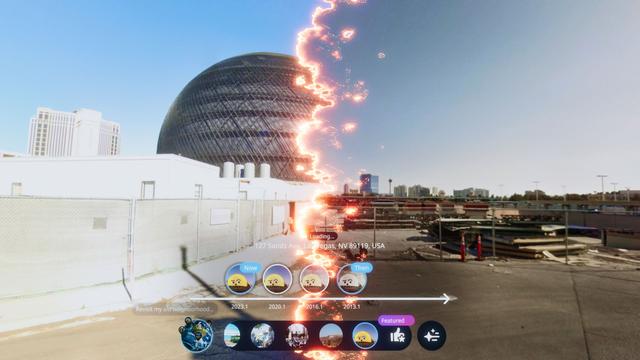
What if you could step back into the world exactly as it was years ago? Not just to see it, but to stand within it—to look around, breathe, and remember?
Revisit is a VR experience for Meta Quest that transforms everyday locations from Google Street View into full-scale, explorable environments. It is not about fantasy or fictional worlds—it is about our own. Whether you’re revisiting the neighborhood you grew up in, walking through a distant museum, or exploring a city that changed before your eyes, Revisit allows you to slip through time and space effortlessly. It fuses the power of VR, Google data, and immersive storytelling to let people travel, explore, and relive their memories like never before.
The app taps into the emotional and educational potential of virtual reality. With Revisit, you can walk the streets of Paris, explore remote temples in Japan, or simply stand in front of your old high school—seeing how it looked in 2009 or how it stands now. It’s both deeply personal and universally fascinating, blurring the line between nostalgia and discovery.
When Technology Becomes a Time Machine
Revisit’s concept is simple yet extraordinary. It leverages Google’s vast Street View archive to bring entire cities into VR, complete with their historical snapshots. Each scene surrounds you in full 360°, captured at life-size scale. It’s not a “virtual replica”—it’s the real image data from specific years, carefully reconstructed for VR immersion. When you slip on your Quest 3 headset, the sense of presence is instant: light glows realistically off surfaces, streets hum with atmosphere, and even the ordinary becomes cinematic.
Unlike many VR experiences focused on fantasy, Revisit is grounded in real geography. Every capture point corresponds to an actual place and time, allowing users to step through the past and compare it directly to the present. The effect is both analytical and emotional—an interface between technology and memory. When a building has been demolished or a shop replaced, seeing it again in its former state is oddly moving, a quiet reminder that the digital record of Earth is also a record of our lives.
Presence Beyond Screens: Why VR Makes It Real
Flat screens can only hint at immersion. In VR, your body becomes part of the data. With Revisit, you don’t pan with a mouse—you turn your head. You don’t zoom—you step forward. The architecture’s proportions are correct; the horizon sits at your true height. This physical alignment creates a deep sense of authenticity that transforms simple Street View panoramas into something nearly tangible.
Revisit’s comfort design is deliberate. You move node by node, just as you would navigate Street View on a desktop, but in VR it feels like walking naturally. The pacing allows your eyes and balance to adapt easily, making it approachable even for newcomers. Each transition feels like stepping into a new photograph that has come alive around you. When you switch between years—say, from 2012 to 2021—the scene transforms seamlessly, revealing urban change or natural restoration. It’s not just a visual trick; it’s a lived contrast that invites reflection on time itself.
Moments That Define the Experience
Consider this: a teacher guides students through Rome’s ancient ruins, not with slides, but by standing inside them. A traveler rehearses a route from hotel to train station, gaining confidence before ever leaving home. A daughter invites her father to revisit the street of his youth and, for a brief moment, brings the past into the present. These are not hypothetical marketing lines—they’re everyday use cases that show what happens when information becomes space.
In one touching story shared by a user, an elderly man used Revisit to see his old house in a small town. With a tap, his daughter switched to an older Street View capture, and the bakery where he once worked reappeared. He instinctively reached toward the counter that no longer existed. “That’s where I met your mother,” he said softly. VR, for once, didn’t separate him from reality—it stitched it back together.
Education, Exploration, and Everyday Travel
Beyond nostalgia, Revisit has enormous value for education and research. Geography teachers can create “time-comparison” assignments: students analyze how neighborhoods evolve, how climate impacts infrastructure, or how public spaces adapt over decades. Architecture programs use it to study urban morphology at a human scale. History educators can demonstrate post-war reconstruction or gentrification patterns by literally standing inside different time periods. The lessons become visceral—students don’t just learn facts, they inhabit them.
Travelers and explorers, too, find practical uses. Planning a trip to Kyoto? Step inside the streets near your ryokan to familiarize yourself with the layout. Visiting a museum across the world? Preview its approach, crowd flow, or accessibility. By reducing uncertainty, Revisit turns anticipation into empowerment. Even people with limited mobility can explore faraway places safely and freely.
How Time Travel Works (Without Magic)
Technically, Revisit functions by loading high-resolution panoramic images from Google Street View into a VR environment. Where multiple years of imagery exist, users can cycle through them instantly. The application maps these spherical captures to the Quest’s rendering pipeline, producing an enveloping, distortion-free scene. Lighting, focus, and motion cues are carefully balanced to preserve comfort and realism. The time-switching mechanic uses Street View’s embedded metadata to align older and newer shots within the same spatial anchor points. What seems like sorcery is actually precise data choreography—technology serving memory.
Because the imagery comes directly from a verified source, every pixel corresponds to a real capture, a real moment. That authenticity distinguishes Revisit from reconstructed VR worlds. This is not an artist’s interpretation; it is Earth as documented by satellites and camera cars, transformed into an inhabitable archive.
Privacy, Trust, and Transparency
As with any experience based on global imagery, ethical design matters. Revisit adheres to the same privacy standards as Street View, ensuring faces and license plates remain blurred. All data is drawn from publicly available imagery governed by Google’s policies. The app itself does not collect or publish personal viewing history. It’s designed for peace of mind and mindful exploration—an educational and cultural tool, not surveillance tech.
Revisit also reinforces transparency by displaying capture years and context for each scene. Users always know when and where a panorama was taken. That clarity makes it valuable for journalists, historians, and urban researchers analyzing long-term change. In classrooms or public demonstrations, it reminds participants that what they see is factual, time-stamped data—not simulation, not fiction.
For Families, Planners, and Dreamers
Each audience finds something unique in Revisit. Families use it as a shared storytelling tool: grandparents recount journeys, parents explain heritage, children explore unfamiliar hometowns. Urban planners analyze historical infrastructure to understand how cities evolve. Dreamers simply roam the world from their living rooms, exploring every coast, alley, and skyline that curiosity suggests. The app doesn’t tell stories—it gives them back to the people who lived them.
Because it runs on Meta Quest, it benefits from the headset’s clarity and spatial precision. The Quest’s advanced tracking allows users to lean in close to examine signage or textures, turning what used to be “flat exploration” into embodied discovery. Sessions are light, intuitive, and immediately gratifying. You can begin with no tutorial, yet find yourself traveling across continents within minutes.
Tips for Getting the Most from Revisit
- Curate your journey: Choose locations tied to personal memories first—they yield the strongest emotional connection.
- Compare carefully: When switching years, align your view with a fixed object (like a lamppost or sign) to make changes more noticeable.
- Share stories: Use Revisit during family gatherings or video calls—everyone can take turns exploring shared history.
- Teach with purpose: In classrooms, let students explore familiar streets to understand how design choices affect daily life.
- Mind your comfort: Keep early sessions short, around 10–15 minutes, especially for those new to VR.
Why It Belongs in Every VR Library
VR has often been celebrated for fantasy, but Revisit champions reality—the kind that once surrounded us and sometimes slips away. It proves that immersion isn’t just for entertainment; it’s for empathy, education, and memory. It captures what technology at its best can do: not replace the world, but remind us of it.
In an era of constant novelty, Revisit slows things down. It invites users to see the extraordinary within the ordinary: the curve of a road before redevelopment, the corner shop before closure, the skyline before growth. It connects people not only across space but across time. For creators and researchers, it’s a documentation tool; for families, a memory bridge; for wanderers, a passport without expiry.
Frequently Asked Questions
- Can I explore any place? You can visit any location covered by Street View imagery. Some areas may not include historical captures, but most major cities do.
- Is internet required? Revisit loads images online; an active connection ensures smooth transitions between scenes.
- Can I use it for education? Absolutely. Teachers and students use it to visualize history, geography, and urban development firsthand.
- Does it cause motion sickness? Its static-node movement design minimizes discomfort. Sessions are generally gentle and accessible for beginners.
- Is it safe for children? Yes. Imagery is sourced from publicly available Street View with privacy protections applied.
- Can I share what I see? You can guide others in-person using screen casting on Quest or share coordinates for them to explore on their own device.
- Does it support multiple platforms? The available metadata indicates it’s developed for Meta Quest. Other platform versions have not been publicly announced.
Revisit is more than an app—it’s a living archive where memory, place, and technology intersect. In its quiet brilliance, it redefines exploration itself: not about where you can go, but when you can return. Step inside, look around, and rediscover the world as it once was—and as it still lives within you.